Australia's "National" Security: Why is the main threat ignored?
Maybe they're trying to tell us "My security is your only real security"

Another review has confirmed the general 1972 ”Limits to Growth” findings, while concluding that we have now begun to go over the cliff and will rapidly accelerate down the other side in the early 2030s. If they are right, industrial affluent consumer society will soon be over. We have had fifty years warning, but still take no notice.

In 2014 Ken Turner reassessed the findings of the original study and concluded that the world is on the track it predicted. The recent study expects that effects will impact much more quickly than was previously expected. 

It says, “The updated World3 model, recalibrated with empirical data through 2022, projects that key human development indicators—including industrial output, food production, and population growth—will peak and begin a steep decline between the mid-2020s and early 2030s. ...Resource depletion is now recognized as the primary driver of the approaching tipping point. ....”  The study predicts “ ... sharp declines in industrial output, food production, and human welfare between 2024 and 2030.” It is saying that “...the world is entering an era of managed or unmanaged degrowth.”

The term now used to refer to the predicament is “poly-crisis”. Most people seem to have little understanding of what this involves or how serious it is.  Following is an indication of its many components and their significance. (Most of the following statistics are from Julian Cribb’s summaries, for instance.)

Resources are becoming more scarce and expensive. ”...ore grades across the world started to fall significantly over the past few decades.” Average grades of copper ores being mine have halved in 25 years. 

Vital Overshoot

Biological resources are dwindling. The World Wildlife “Footprint” measure indicates that humans are using them at almost twice the rate at which nature can sustainably provide them. The world's total amount of productive land is about 12 million hectares, meaning the amount per capita is around 1.5 hectares. However the Australian per capita rate of use of productive land about 6 to 7 hectares. If we left one-third of the productive land to nature we Australian per capita use would be over six times as much as would be sustainable if shared by all people. 

Serious Energy Dependency

We will be heavily dependent on petroleum for decades to come, regardless of the adoption of renewable sources. But supply is likely to peak in the next decade or so as the fracking sector declines steeply. 

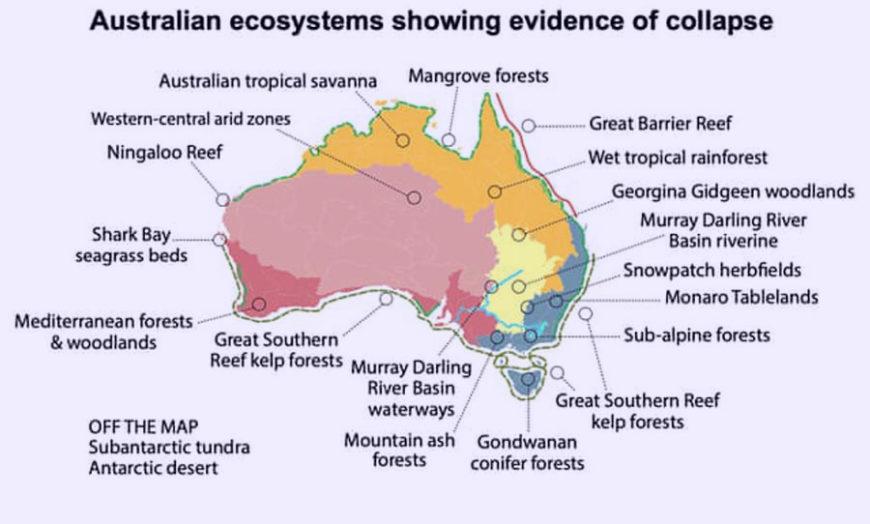
Nineteen Identified Australian Ecosystems in Danger

Environmental damage is widespread and alarming. We are in what is being labelled the sixth extinction holocaust in the last half billion years. The average population size of wildlife has declined by a staggering 73% between 1970 and 2020. This is mainly because humans are taking so much natural habitat. Humans plus their cattle make up an incredible 99% of the large animal biomass on the planet! The rate at which species are becoming extinct is at least one thousand times as fast as it would be without the human contribution.  It is estimated that around 150 species are lost every day. not including micro-organisms.
Forests are being lost mainly because land clearing is taking place at an unacceptable rate. About 10 million ha are lost each year. Australia’s rate of land clearing is one of the worst in the world, over half a million ha per year and increasing 40% in 2025 alone. 

Oceans are being degraded at an accelerating rate, becoming more acidic and polluted, forming ocean dead zones due to fertilizer and nutrient run off, carrying high plastic loads, and expanding due to heat absorption. Climate change is reducing the Atlantic currents keeping Europe warm. The loss of oxygen from the world’s oceans is approaching critical levels. Globally, the ocean has lost about 2% of its dissolved oxygen since the 1950s and is expected to lose up to 7% by 2100.

Polar ice sheets are approaching tipping points, committing the world to several metres of irreversible sea-level rise that will affect hundreds of millions. 

Most world fisheries are being harvested beyond sustainable rates and many are collapsing. “Overfishing, pollution, habitat destruction, and climate change are decimating marine species at frightening speeds.” Catches have been declining since the 1990s. “...seabirds ... have sustained a massive global population crash of more than 70% since the 1950s.” 

Fresh water is a major problem in many areas. Global sources have declined markedly, especially since 2014. Soils are being damaged and lost due to erosion, overuse of fertilizers, loss of their carbon, acidification, compaction, pollutants and non-return of nutrients. “Every day, the food you eat and resources you use cost the planet at least 12 kilos of lost topsoil.” There is concern that agricultural capacity will be seriously reduced by 2050. “Soil loss and resulting food scarcity is fast becoming the biggest unseen threat to the human future.”.. 60% of the Earth’s 
land area is now in a precarious state of degradation.” 

We are poisoning the planet. “Humans discharge as much as 220 billion tonnes of chemical emissions into the environment every year, poisoning every person and living creature.” This is one of the planetary boundaries we have exceeded.


These many factors are damaging the biological systems that maintain the conditions needed to sustain all life on earth. Scientists have identified 9 safe “Planetary Boundaries” for impacts. We have already exceeded 7 of them. 

Economy collapses along with our biosphere

More imminent than these bio-physical threats is the looming and inevitable global financial collapse. Global debt is now around three times what it was before the GFC, and is accelerating. Lenders will suddenly realise that they are never going to get their loans back, so will suddenly panic terminating credit, investment, trade and crashing banks.

And few realise how rising inequality alone can destroy whole civilisations. Luke Kemp’s Goliath's Curse documents many cases throughout history. It has produced Trump and the emergence of fascism. 

Thus the CO2/climate problem is just one item on a long list. The compounding difficulties and costs are already impacting and are accelerating. What will be their combined effect by 2050?

The high “living standards” we boast could not be delivered unless the economies of poor countries were not geared to the export of cheap resources to the rich countries via a development model which traps them in impossible levels of debt.  Hickel estimates the resulting net transfer of wealth from them to us at $2.5 trillion p.a.  

And consider the implications for our geopolitical future. Most of the armed conflict in the world is caused by the struggle to grab resources. As they become more scarce and capitalism seeks to increase production and consumption, armed conflict will inevitably increase. 

Time to abandon ship for the life-boats?

To summarise, firstly there is a long, detailed and very strong case that we are heading for a mega-collapse within at best two decades, and secondly that a just and sustainable world order cannot be achieved unless levels of consumption and affluence are dramatically reduced. There would have to be huge degrowth to far simpler lifestyles and systems. (See and the video.)

Yet the rhetoric and expenditure devoted to “national security” pays not the slightest attention to any of this. Where are the think tanks assessing the prospects of collapse, the fragility and lack of resilience of our systems, the mentality at official and public levels guaranteeing refusal to think about the issue? Spending $380 billion on submarines isn’t going to help with these threats to national security. Never mind, Pat Cummins’ back should be OK for the third test.

The economic system we have inevitably, unavoidably generates and accelerates all these problems. It is grossly unsustainable. The many factors noted above show that the amount of producing and consuming going on is far beyond sustainable levels, yet this economic system must have growth without limit and all our politicians and economists are working frantically to promote it.

It is also driven by market forces which ensure that it that attends mainly to the demand of the rich and not to the needs of individuals communities or ecosystems. inevitably creates greater on resource and environments. It forces poor countries to adhere to a development model which enriches rich world corporations and consumers, transferring trillions of dollars in net wealth from themselves to rich investors and shoppers every year. This prevents them from applying their resources to developing the systems that would provide for their people. How affluently would we live if we were not benefiting from this looting? What would your mobile phone cost if those digging the tantalum got a decent wage? How much of your chocolate is produced by child slavery? 

"Breaking bad"

It is an economy that inevitably generates grotesque levels of inequality. Few realise that inequality eventually destroys societies and even whole civilizations. The rich get increasing control of the political system and can ensure that laws favourable to them are passed. Eventually this process impoverishes people and generates discontent and weakens social cohesion which can bring down the whole system. Various works document this sequence, such as Luke Kemp’s Goliath's Curse.

The grossly unacceptable economic situation cannot be remedied without large scale degrowth in the rich world and a shift to a very different system driven by need  not profit or market forces, and involving far lower levels of production and consumption.

Not the least concerning element in the poly-crisis is the accelerating social breakdown caused by the above factors. A general loss of social cohesion is gathering momentum. The incidence of personal stress is increasing, including family conflict, drug and alcohol abuse, youth suicide, loneliness, an epidemic of stress, anxiety, depression and mental illness, eating disorders and obesity,  the proportion of Australians who live alone, reductions in the average number of close friends, number of neighbours known, parents who would allow their children to roam the neighbourhood, the number of organisations and associations, amount of volunteering, organised sport, number of close friends, membership of political parties, money donated.

In addition to these personal effects social systems are being seen as increasingly dysfunctional and incapable of meeting demands. Societies are becoming polarised between rich and poor. Young people in general can’t expect to own a home and are experiencing more struggle and worse conditions than their parents...while the rich get richer and richer. Some countries have appointed ministers for loneliness. Rural life is decaying.  Over 120,000 people in Australia are homeless. (On average they live 28 years less than the average.) There is increasing discontent with governments, leading to political apathy and cynicism, diminishing support for democracy and increasing support for authoritarian governments. 

Social Breakdown

There are also the undesirable moral and cultural effects of an economy driven by individualistic winner-take-all competition for wealth. It forces everyone to be preoccupied with struggling to succeed in the quest for money and property, when a sensible society could eliminate most work and allow us to devote our lives to enjoyable and much more important pursuits. It imposes patriarchal relations on us as we all exist in hierarchies of power and domination.

We are surrounded by undesirable structures and behaviours, such as advertisers who deliberately try to deceive us. Struggling to get enough money to live creates a world view that is about buying, trading, “transactions” and exchanging to maximise gain. This is a self-interested mentality, not a collectivist caring climate as exists in a good family or community where the primary concern is the welfare of all. We learn that these conditions are “normal”, when they are actually paltry and stultifying.

The most urgent and alarming element in the poly-crisis is the imminent financial crisis. Many now believe it will impact within five years. World debt levels are extremely high, they cannot be paid off and they are increasing fast. At some point before long lenders will realise they are not going to get their money back and will cease making capital available.  It is difficult to see how the system can avoid rapid collapse.

The basic cause of the economic situation is the diminishing disposable income of most people as the proportion of national income going to the rich increases.  Banks, supermarket chains and developers are making record profits while one third of Australians are reported to be going without sufficient food. Governments try to stimulate the economy by making more money available but borrowers can’t set up new factories to produce goods to sell because people don’t have the money to purchase more products, (...so borrowers use the money to buy up more assets to rent.)

Resource scarcity and costs will continue to increase, making profitable investment more difficult. Governments will be impacted by the rising demands made on them and sluggish income and tax growth, leading to drastic cuts in spending on welfare, and therefore to rising hardship and discontent, and increasing political turmoil, furthering the deterioration in democracy.

At the geopolitical level most of the conflict in the world is caused by the struggle to grab resources. As they become more scarce and capitalism seeks to increase production and consumption, armed conflict will inevitably increase.

The above outline of the situation is documented at greater length in ThePoly-crisis.
Few seem to grasp the multi-factorial nature of the predicament nor its combined seriousness or magnitude. It is a complex interdependent house of cards in which any one of many weak links could trigger a chain-reaction cascade of collapses. Modern global trade, financial networks and “just in time” delivery systems have eliminated local resilience.

In a few weeks stocks in warehouses and oil tanks can be exhausted. We have lost our capacity to manufacture the spare parts and the skills to grow or repair necessities. There is no official recognition of the enormous threat the poly-crisis constitutes for national security, let alone any thinking at governmental or public levels as to what steps could be taken to provide some capacity to cope if/when the crunch comes. Where are the neighbourhood and town committees thinking about what steps they might be wise to take?  There is no thinking taking place along these lines.  Purchasing submarines won’t help with this threat to national security.

Here's an indication of The Simpler Way perspective on the situation..

    1. We are totally incapable of defusing the problem ... firstly because it is not even recognised and secondly because all our structures, commitments, values and aspirations are headed in precisely the wrong direction.  Try telling treasurer Chalmers or the typical supermarket shopper that the pursuit of growth is now not just absurd but suicidal and that we must cut production, consumption, work, trade, investment and the GDP by 80% ... and see how you go.

    2. And it’s too late anyway. Some analysts think you are likely to be stumbling over the rubble as early as 2026. If we are lucky it will be a slow-onset beginning, jolting people into realising that their only hope is to come together to develop in their neighbourhoods and towns some kind of Simpler Way as fast as possible.

nbsp;   3. There is only one general form for a society that can achieve the necessary degrowth while ensuring a good quality of life for all. It must involve most people living in small scale, highly self-sufficient and self-governing, cooperative communities, willing to live with materially simple lifestyles and systems. Only such a form can get the resource demand and ecological impacts right down. On Dancing Rabbit ecovillage in Missouri capita resource use rates are 5-10% of US national averages. Per capita household electricity use at Pigface Point homestead is around 1-2% of the national average. And these numbers would be much lower if these settlements were within regions with highly self-sufficient economies, enabling for instance all food to be produced close by and all nutrients to be recycled to gardens. This would dramatically reduce if not eliminate the need for many inputs into food and other production such as trucking, chemicals, packaging, advertising, “waste” removal, fertiliser production and sewers.

    4. It is highly likely that there will be an enormous collapse of the global system within the next few years, triggered by the financial situation, creating much more damage than the GFC caused. (Debt levels are now much higher.). Some see this being patched up by QE, without fixing anything substantial, only to set up the final catastrophic debacle in the early 2030s.

    5. What then should we do? Firstly try to refute the foregoing account of the situation. If you more or less agree with it, at least help us to get it on the agenda for public discussion. Many are now trying to implement the alternative ways in ecovillage, transition towns and degrowth movements. The prospects for salvation are not at all good but if you are concerned about national security I suggest that you should join them.

author:
Ted Trainer
description:
Ted Trainer writes on how modernity is hitting "hard limits". The timeline and trends are very scary. We should focus on what needs to be done.
keywords:
Limits to Growth models show Modern Techno Industrial Civilization, is now going "over the cliff", and will rapidly accelerate down the other side in early 2030s.
og:title:
Australia's "National" Security: Why is the main threat ignored?

Add Comment

* Required information
1000
Drag & drop images (max 3)
Enter the word shark backwards.
Captcha Image

Comments

No comments yet. Be the first!